Mentor/Coach
Mentoring. As maintained by Bozeman and Feeney (2007), Kram in 1985 conceptually defined the basic aspect of mentoring as a two-fold interpersonal process by which “a senior or more experienced person (the mentor)” engages a less experienced person, the so-called “protégé,” in an ongoing relational exchange that offers, first, “advice or modeling about career development behaviors,” and second, delivers the protégé or mentee, “personal support, especially psychosocial support” as they develop (p. 722).
Coaching. In 1996, Peterson and Hicks defined coaching as the “process of equipping people with the tools, knowledge, and opportunities they need to develop and become more successful” (cited in, Hughes, Ginnett, & Curphy, 2012, p. 69). As stated by Hughes et al. (2012), “there are two types of coaching: informal and formal” (p. 69).
Coaching. In 1996, Peterson and Hicks defined coaching as the “process of equipping people with the tools, knowledge, and opportunities they need to develop and become more successful” (cited in, Hughes, Ginnett, & Curphy, 2012, p. 69). As stated by Hughes et al. (2012), “there are two types of coaching: informal and formal” (p. 69).
Competency 2b: Mentor/Coach
Introduction
The Andrews University Leadership Department advances a set of leadership competencies, which require students to have “theoretical knowledge and practical application” within a set of “core [leadership] competencies” of which the “leadership of others” is one group of competencies (Leadership Handbook, 2011, p. 36). This second group of leadership competencies addresses “the interpersonal aspects of leadership,” along with the “growth and development of others,” which is integral to the leadership function (Leadership Handbook, 2011, p. 36). Regarding the competency of mentoring, or coaching, “leadership promotes relationships that are trust-centered, providing the kind of empowerment that results in personal and performance improvement toward satisfying mutual objectives” (Leadership Handbook, 2011, p. 36).
As a Christian and leader of a non-profit, I see that my model of equipping others is found, first, in Jesus Christ, who showed the importance of investing in people, equipping them and then entrusting to them work that is eternal in significance. Second, mentoring and coaching are outflows of the strategy of Jesus. Both these dimensions of equipping and developing others have become the defining themes of my life as a leader.
My objective is to continue to grow and develop leaders around me in the context of my work in leading The Matzevah Foundation (TMF). To this end, I desire to deepen and broaden my knowledge base.
My reflection paper will reflect what I have learned about mentoring and coaching and will illustrate how I have applied these theoretical constructs to my life and work as a leader.
As a Christian and leader of a non-profit, I see that my model of equipping others is found, first, in Jesus Christ, who showed the importance of investing in people, equipping them and then entrusting to them work that is eternal in significance. Second, mentoring and coaching are outflows of the strategy of Jesus. Both these dimensions of equipping and developing others have become the defining themes of my life as a leader.
My objective is to continue to grow and develop leaders around me in the context of my work in leading The Matzevah Foundation (TMF). To this end, I desire to deepen and broaden my knowledge base.
My reflection paper will reflect what I have learned about mentoring and coaching and will illustrate how I have applied these theoretical constructs to my life and work as a leader.
Documentation of Competency 2b: Mentor/Coach
Please find below, the documents, photographs, certificates, etc.that best represent and illustrate the artifacts, verifications, and / or evaluations that I have generated and received related to Competency 2b: Mentor/Coach.
In this competency, I have learned theoretically about mentoring and coaching along with the practical application of these leadership disciplines to my work in leading The Matzevah Foundation, Inc.
PLEASE NOTE: You may access each file by clicking on the link. The document will open into a new window for your review. You may download and save the file or print if you wish.
In this competency, I have learned theoretically about mentoring and coaching along with the practical application of these leadership disciplines to my work in leading The Matzevah Foundation, Inc.
PLEASE NOTE: You may access each file by clicking on the link. The document will open into a new window for your review. You may download and save the file or print if you wish.

A group of Jewish students map out their project in a Jewish cemetery in Poland, May 2018.
Artifacts
Verifications / Evaluations
- Unit 501-Building Blocks for Powerful Coaching
- Class Notes_1
- Getting Started in Coaching
- The Strategy of Mentoring and Multiplying Leaders
- Process of Amending TMF By-Laws
- Hour Glass Coaching Model
- Request for Feedback
- Nasielsk Cemetery Clearing with The Matzevah Foundation
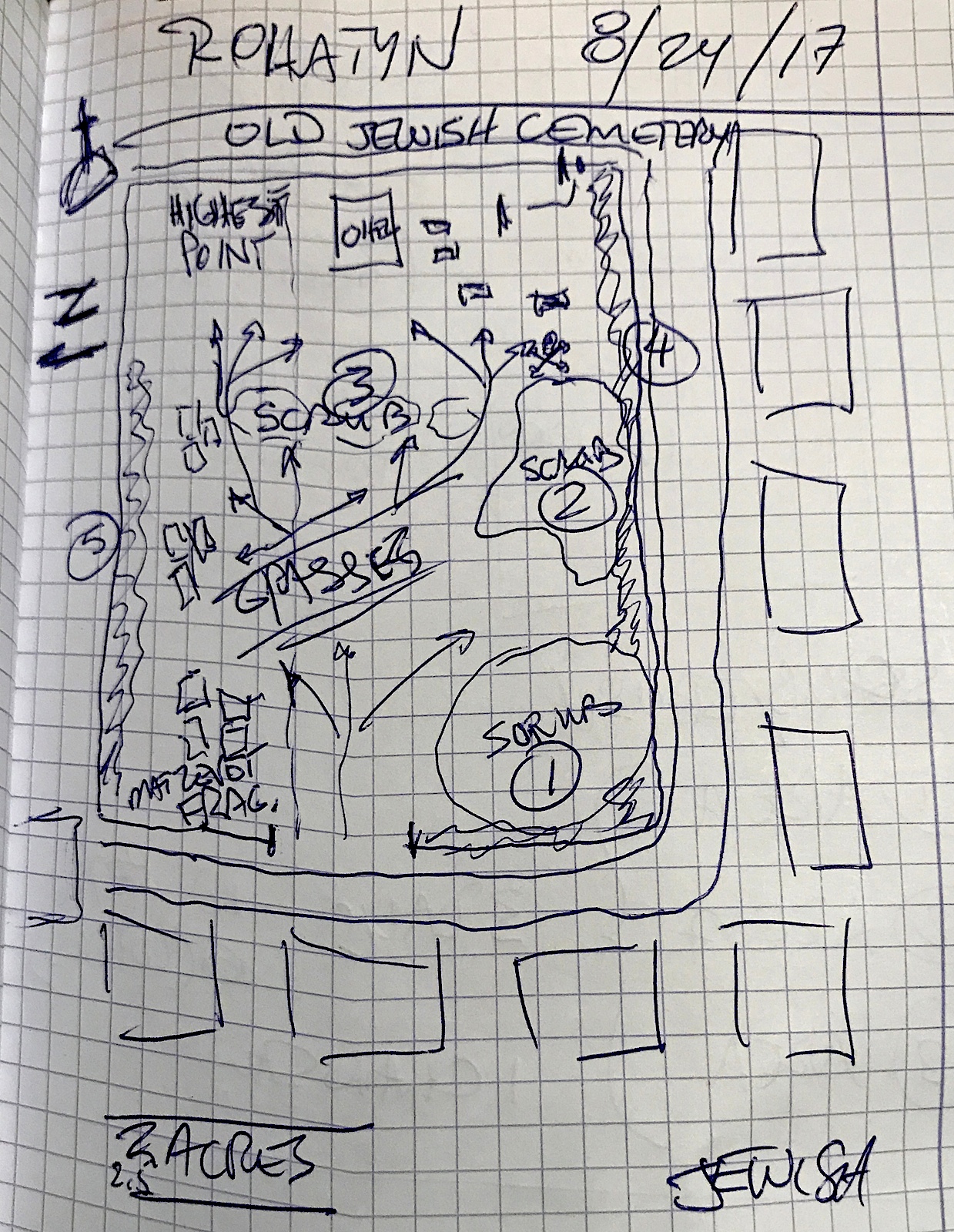
- Rohatyn Cemetery Sketch_1
- Rohatyn Cemetery Sketch_2
- TMF Appeal for Funds
- RE Coaching Troika
Steven has guided me in my work in order to help me better develop goals for my organization and be more effective in achieving them. Steven has mentored me through advice and example (both words and deeds) to support my practical and personal development.
- Focus on Leadership Certificate
- Project Nehemiah
- Project Nehemiah 2011
- TMF Vision Mission Statements
- Agenda TMF Board Meeting 12-April-2014_Mentoring
- 2017 Oct TMF Board Meeting Minutes_Leadership Dev.
- Markuszów - July 2016 Final Report
- Re Trzcianne cemetery
- RE Request for Feedback
- Conversation with Stephen
- EJC 2015 Conf Brochure
- The Matzevah Foundation Visits Rohatyn’s Old Jewish Cemetery
- 2017 Oct TMF Board Meeting Minutes_Rohatyn
- Brush Clearing at Rohatyn’s Old Jewish Cemetery
- Steven and Marla Interview Video Clip
- J Osborn feedback
- M Raucher Osborn feedback
- RE Coaching update_1


Reflection Paper
You may read my reflection paper by following the link for Competency 2b: Mentor/Coach. It is also available below for you to view or download. Use the rubric on the ParticipantHub - Steven Reece to guide you in reaching your score for the desired level of competence.

Bruce Mussey, left, Marla Raucher Osborn, middle, and Steven Reece, right, ride through the Ukrainian countryside in August 2017.

Marla Raucher Osborn in Rohatyn, Ukraine, August 2017.
Reflection Paper Evaluation Rubric
As a reviewer, you may score my Competency 2b: Mentor/Coach reflection paper on my ParticipantHub page - Steven Reece (links below). PLEASE NOTE: You will need to select the appropriate link based on your role (Peer, Advisor, or 2nd Reader). A separate page will open and you be directed to the Andrews LearningHub where you must log in to use the following links: